 04_GB_17_Day_1_Haslemere_support_coach_26_4_2025.jpg (131705 bytes)
|
The Railfaneurope.net Picture Gallery
Directory: /pix/new/12_dec17-gb1
Last update: Wed 17 Dec 17:25:55 GMT 2025
|
| GB_17_Day_1_Haslemere_support_coach. CLAN LINE is a regular locomotive for hauling the Belmond British Pullman train so the locomotives support crews coach, a British Railways Mark 2, Brake/First, is painted in Pullman colours and named MERCATOR; Haslemere. 26th April 2025. roger.griffiths@hotmail.com |
| GB_17_Day_6_Wick_station_47832. 47832 rests inside the well-maintained, overall-roofed station at Wick, facing a drawing of a type of locomotive built specifically for working over the line between Inverness and Wick: a Jones Highland Railway 4-4-0 No.68 CAITHNESS (1874 - 1907). Caithness was the former Scottish county which included the town of Wick; today it is simply the Highland council region. The stencilled panels on the cabside of the diesel tell us it is a Class 47/A with a weight of 119 tons and a brake force of 60 tons. ETH Index 66 indicates that the locomotive is fitted for electric train heating and air-conditioning. One ETH Index is about 5kw, so an Index of 66 means 47832 can provide 330kw of power for ancillary services. RA 6 is the Route Availability for weight and the locos maximum speed is 95mph (152kph). Finally, the oval containing 10A goes back to British Railways steam days, when locomotives carried an oval plate on the smokebox door, indicating the number/letter code of the engine shed where they were based. 10A was the London Midland Region code for Carnforth engine shed, today the home base of West Coast Railways. 1st May 2025. roger.griffiths@hotmail.com |
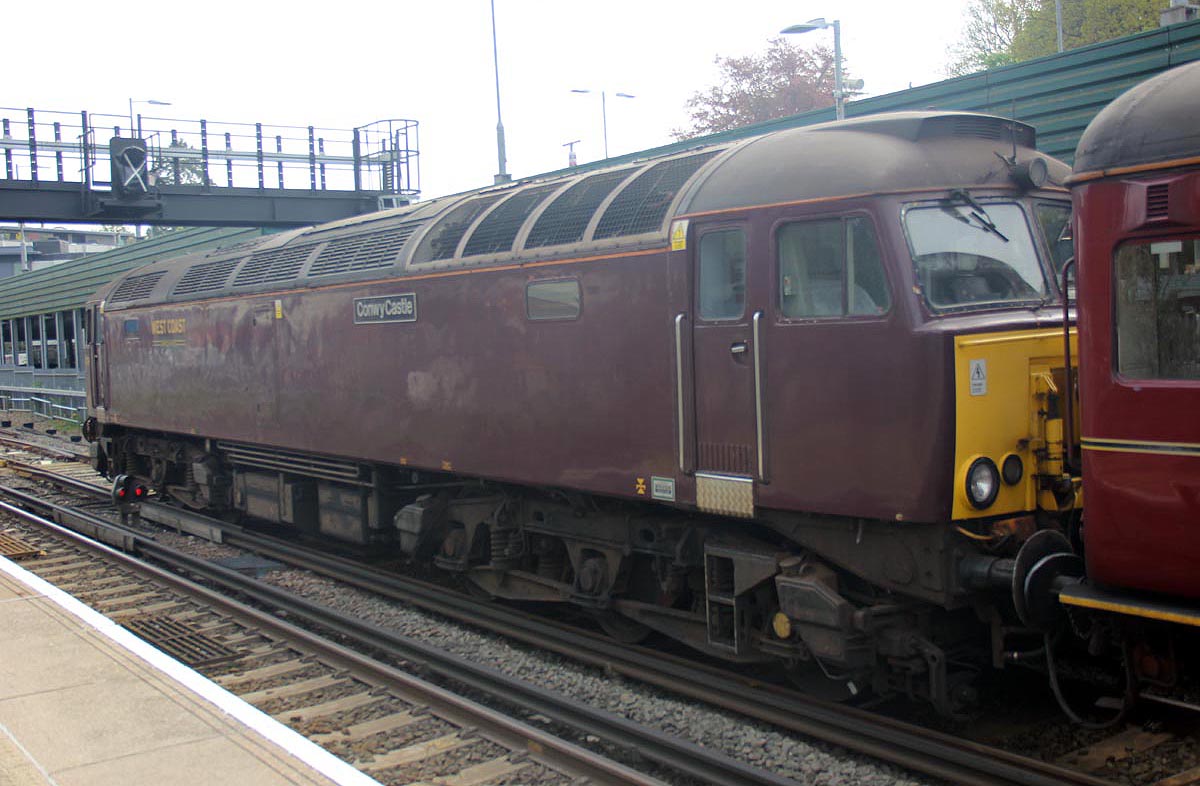
| GB_17_Day_3_57314. Day 3 for the GB17 train was planned for 45212 to go from Cardiff, via the Welsh border line, through Hereford and Shrewsbury, to Chester and from there to Warrington and the West Coast Main Line (WCML), to Carnforth. Plans had to be drastically changed though, when 45212 was found to have run a hot tender axle box and the Welsh border line was blocked by a culvert collapse. So, Brush diesel 57314 took the train from Cardiff, via Gloucester, Birmingham and Wolverhampton, to Crewe and the WCML. 57314 was delivered in August 1965 as D1891, being converted to Class 57 when the original Sulzer diesel engine was replaced by an EMD model, thereby prolonging the locos already long life. The locomotive bears the name of the north Welsh CONWY CASTLE (CONWAY in English). 28th April 2025. roger.griffiths@hotmail.com |
| GB_17_Day_5_Kingussie_66422. While TORNADO was taking water at Kingussie, Direct Rail Services Class 66 diesel No.422 passes, heading south with the Tesco Express, a container train, sponsored by the supermarket chain. 30th April 2025. roger.griffiths@hotmail.com |
| GB_17_Day_5_Inverness_66726. On arrival at Inverness, passengers off the GB17 train were met by the Caledonian Sleeper, waiting to depart on its overnight run via Glasgow, to London , Euston. Haulage to Glasgow was behind GB Railfreight Class 66 No.726 with coupled inside, Class 73 electro-diesel No.970, which provides electric heating. Between Glasgow and London, haulage is normally a Class 92 electric locomotive. 30th April 2025. roger.griffiths@hotmail.com |
| 11 GB_17_Day_3_Crewe_57314_Avanti. To fit in the revised route timing for the GB17 there was a long stop at Crewe station, where 57314 posed alongside an Avanti West Coast Class 805 EMU, with an express for Holyhead. 28th April 2025. roger.griffiths@hotmail.com |
| 49 GB_17_Day_7_ Slochd summit. Travelling south, there are two major summits on the Highland Main Line between Inverness and Perth. The first, reached after a 23 mile (37km) climb, is Slochd Summit, marked by this lineside sign. 2nd May 2025. roger.griffiths@hotmail.com |
| GB_17_Day_7_ Druimuachdar Summit. After leaving Aviemore the GB17 faced a climb of 30 miles (48km), to the second of the aforementioned summits and the highest point on the British Railways network - 1484 feet, 452 metres - at Druimuachdar Summit. In Gaelic the name means High Ridge, in English the name was spelled Drumochter. 2nd May 2025. roger.griffiths@hotmail.com |
| GB_17_Day_7_Aviemore_engine_shed. Having descended from Slochd, the GB17 stopped at Aviemore for water, after running in past the former Highland Railways 1898 engine shed, now used by the heritage Strathspey Railway. 2nd May 2025. roger.griffiths@hotmail.com |
| GB_17_Day_7_ Aviemore_station. Aviemores largely wooden station retains many period features, kept in excellent condition by Network Rail. This includes the original gas lights, long since converted to electricity. Note the long platform, from the days when Aviemores many tourists used to arrive and depart by train - sadly not the case today. 2nd May 2025. roger.griffiths@hotmail.com |
| GB_17_Day_4_Carlisle_M&CR_goods_depot. Partly visible in the background of the previous picture is this building, another remarkable survivor from the early days of Britains railways. The sign proclaims it to be the MARYPORT AND CARLISLE RAILWAY GOODS AND COAL DEPOT, which railway first ran trains to Carlisle in 1843 and ceased to be after midnight, on 31st December 1922 when it became part of the LMS. So, still standing is a 182-years old building with sign writing for a company which ceased to exist almost 103 years ago! It is today used as an events venue but sadly has not so far received Listed status. 29th April 2025. roger.griffiths@hotmail.com |
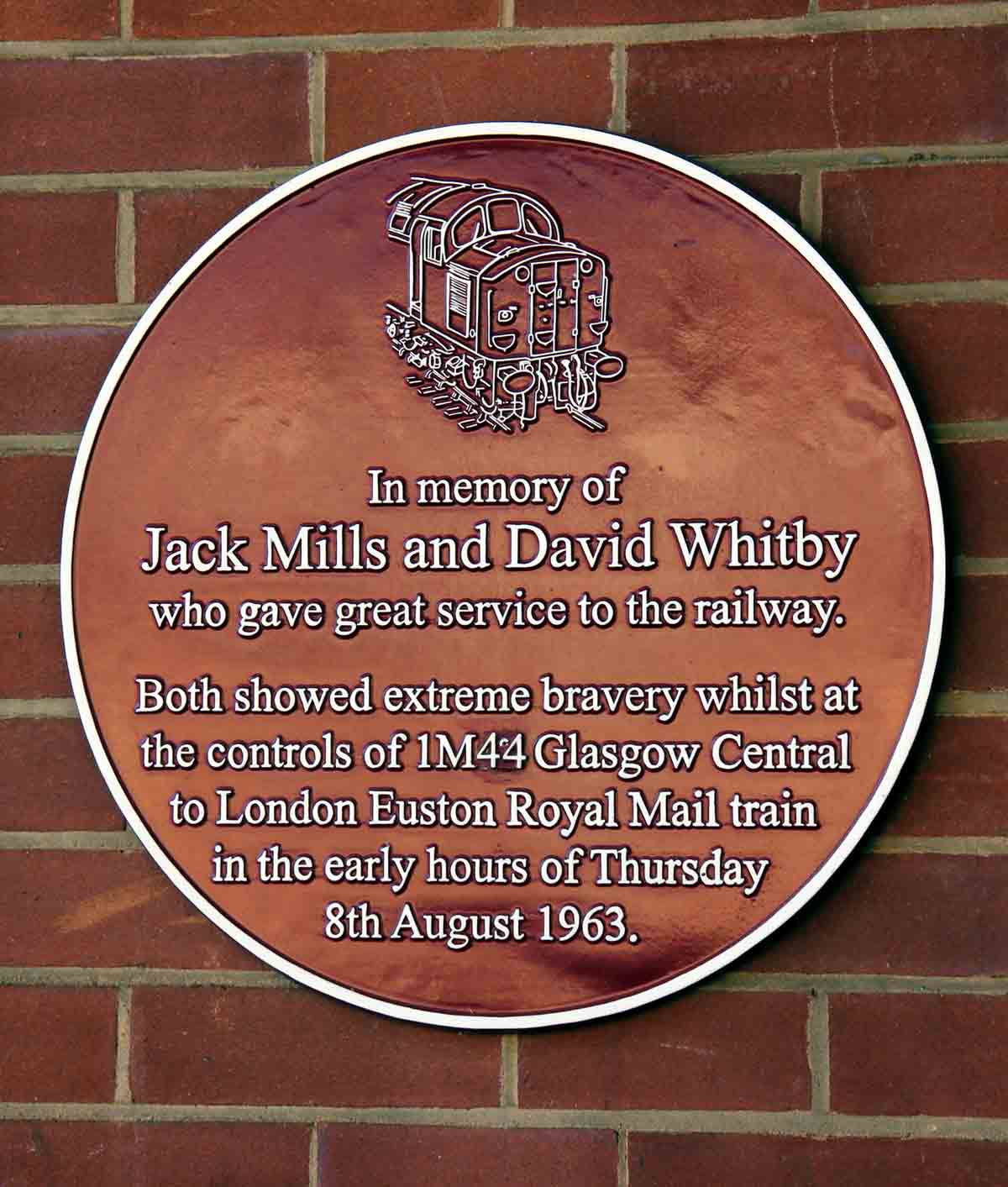
| GB_17_Day_3_Crewe_memorial_plaque. On 8th August 1963, Britains biggest theft, up to that time, occurred when a Glasgow to London Royal Mail train was stopped by false signals and about £2.6 million (some £70 million today!) in old banknotes was stolen. The engine driver Jack Mills, 57 years old, was severely beaten and forced to drive the train a short distance for the stolen money to be off-loaded into road vehicles; 25 years old second man (fireman) David Whitby was also roughly handled by the thieves. After the event, both men had trouble coming to terms with their ordeal; Jack Mills never again drove a train and died only seven years later. Just as tragic, David Whitby died of a heart attack two years after Jack Mills, at age 34. This commemorative plaque was fixed to the wall of Crewe station on the 50th anniversary of the robbery; it is sited just a few yards from where Crewe North engine shed once stood, where both men were based. 28th April 2025.roger.griffiths@hotmail.com |
| GB_17_Day_7_Inverness_I&NR_engine_shed. This building was the Inverness & Nairn Railways engine shed at Inverness. It served between 1855 and 1863 before being incorporated into the Loch Gorm Workshops of the Highland Railway, but returned to locomotive and railcar use after the end of steam. 2nd May 2025. roger.griffiths@hotmail.com |
| GB_17_Day_4_Carnforth_cafe_exterior. During the early months of 1945, director David Lean filmed Brief Encounter, with a screenplay by Noel Coward. Brief Encounter is widely regarded as one of the best British films ever produced, much of the location work being done on Carnforth railway station, which bore the fictional name MILFORD JUNCTION. Apart from some atmospheric sequences of steam in the late years of the London Midland and Scottish railway, a lot of the action centred upon the station cafe, which after closure many years ago has been resurrected and restored as closely as possible to the premises as they appeared in the film. The exterior of the cafe sports a poster for the LMSs pre-war streamlined train The Coronation Scot and a LMS luggage barrow converted into a seat; the only reminder of the present day is the CCTV camera. 29th April 2025. roger.griffiths@hotmail.com |
| 67_GB_17_Day_8_Church_Fenton_service_stop. Once out from under the overhead electric catenary, the GB17 stopped at Church Fenton station to take water and have coal moved forward in the tender. The red sign hanging from 60163s cab is a NOT TO BE MOVED plate, its purpose as a safety device needing no further explanation. 3rd May 2025. roger.griffiths@hotmail.com |
| 68_GB_17_Day_8_Church_Fenton_original_station. There is another relic of Britains railways at Church Fenton. This is the original station, built by the York and North Midland Railway, for the 29th May 1839 opening of a line from Church Fenton, via Wetherby, to Harrogate, a route which finally closed on 4th April 1966. From the differing stonework the now privately occupied station building had obviously been extended on the left, at some time. 3rd May 2025 roger.griffiths@hotmail.com |
| GB_17_Day_6_Helmsdale_mile_post. On the platform at Helmsdale station is this very old mile post, showing that Helmsdale is 101 1/2 miles (162km) from Inverness. 1st May 2025. roger.griffiths@hotmail.com |
| GB_17_Day_6_Helmsdale_signal_box. The gorse-covered hills of Helmsdale provide a background to the stations now disused signal box. Control of trains over the Far North line is by RETB (Radio Electronic Control Block) signalling, which provides in-cab instructions to drivers for proceeding over the numerous single-line sections of the route. 1st May 2025. roger.griffiths@hotmail.com |
| GB_17_Day_6_Wick_station_ornament. Day 6 of the GB17 took the route from Inverness to the Far North, at Wick, a route that had not seen a steam locomotive for many years. Because of the distance involved - 161 miles (257km) each way - the journey north to Wick was behind diesel Class 47 832, with the return trip being hauled by Stanier Class 5 No.45407. At Wick, passenger were left in no doubt where they were by this station ornament made from old whisky barrels. 1st May 2025. roger.griffiths@hotmail.com |
| GB_17_Day_6_Wick_engine_shed_1954. HOW IT ONCE WAS. Wick engine shed in 1954, but none of the locomotives seen here were based at shed code 60D: Wick. Stanier Class 5, 4-6-0 Nos.44991, 44992 and 44798 were all allocated to the main Divisional depot at 60A Inverness. roger.griffiths@hotmail.com |
| 76_GB_17_Day_9_Stowmarket_station. Because of the GB17s changed routing, a previously unplanned stop for water was made at Stowmarket, with its beautifully preserved railway station. Opened in 1846 by the Ipswich and Bury Railway, the buildings Jacobean style was to the design of architect Frederic Barnes. 4th May 2025. roger.griffiths@hotmail.com |
| 65 GB_17_Day_8_Newcastle_tank. A link with the past at Newcastle Central station is this water tank, built by the North Eastern Railway in 1891. It held 60000 Imperial gallons of water (272250 litres) and stands upon the site of an earlier engine shed; an adjacent siding was the usual base for Newcastle stations west end standby locomotive - in BR steam days, invariably a Class A3 Pacific. The water tank is presently disused but protected by a Grade 2 Listing as being of historical importance. Its guardian, Network Rail, is hoping to put the building to a useful new purpose. 3rd May 2025. roger.griffiths@hotmail.com |
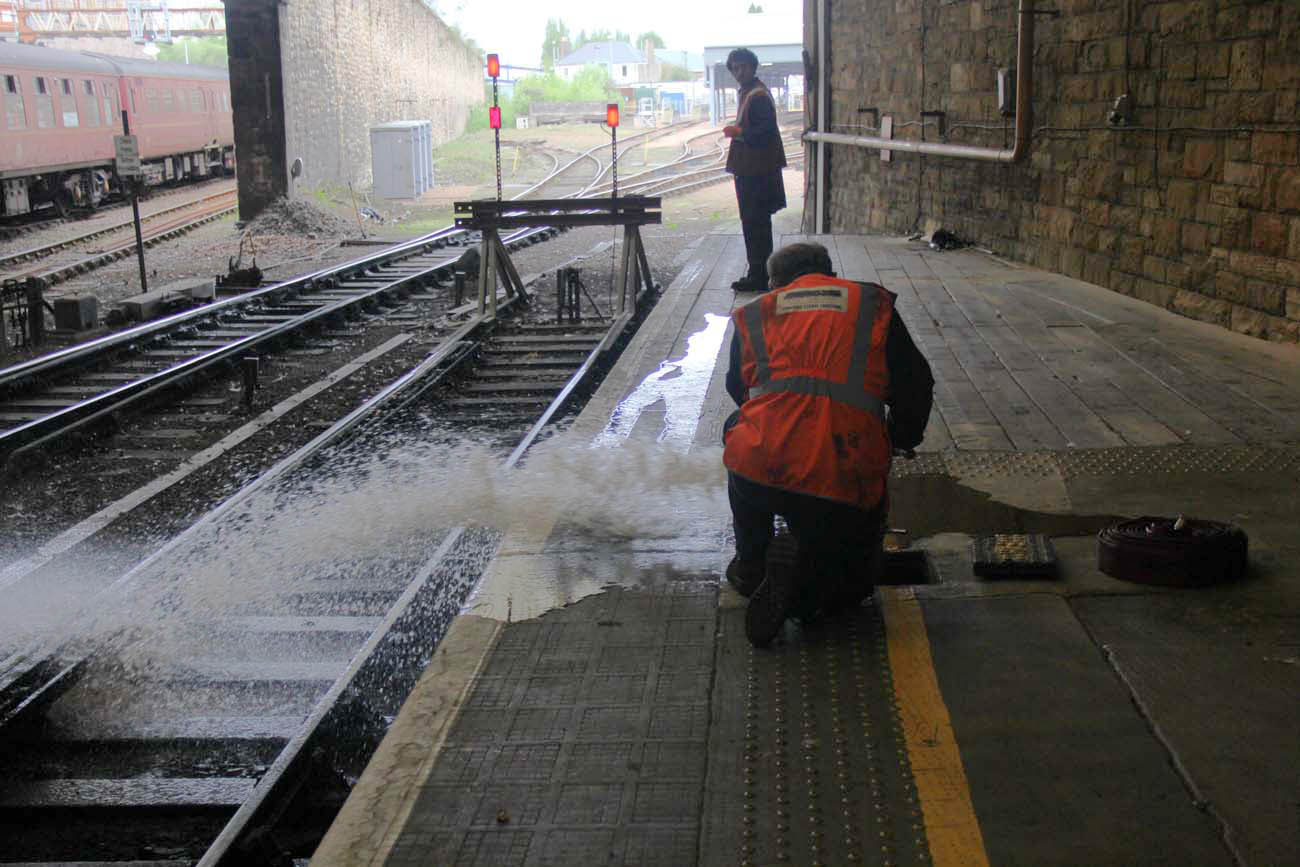
| 57 GB_17_Day_7_ Aviemore_Perth_watering. Before connecting the watering hosepipe to TORNADOs tender, the hydrant on Platfom 3 had to be tested. Was there waterā Yes! 2nd May 2025. roger.griffiths@hotmail.com |
| 59 GB_17_Day_7_Perth_station_footbridge_plate. The pedestrian footbridge connecting Perth stations platforms carries this plate, fitted by the engineering company which provided the steel components for rebuilding the bridge during 1893/4 re-signalling works. Alexander Findlay and Company was founded in 1888 and eventually became part of the publicly-owned British Steel Corporation. 2nd May 2025. roger.griffiths@hotmail.com |
| 60 GB_17_Day_7_Perth_station_murals. Platform 1 at Perth station is decorated with a group of murals depicting the development of the trains which have used the station over the years, from the early days, through the British Railways steam period, up to the present day's diesel multiple units. 2nd May 2025. roger.griffiths@hotmail.com |
| 61 GB_17_Day_7_Perth_station_mural-plaque. The wall murals at Perth are accompanied by this plaque, showing they were hand-painted by local school children. 2nd May 2025. roger.griffiths@hotmail.com |
| 62 GB_17_Day_7_Perth_station_(D&P line). On the east side of Perth station are Platforms 1 and 2, where trains to and and from Dundee are accommodated. 2nd May 2025. roger.griffiths@hotmail.com |
| GB_17_Day_6_Tain_45407_water_tanker. Road water tankers were an essential feature of the GB17 train which was followed throughout its journey. Here, a long way from its home, a Cumbrian-based tanker replenishes 45407 at Tain. 1st May 2025. roger.griffiths@hotmail.com |
| GB_17_Day_6_Tain_station_plaques. Tain railway station has been preserved in excellent condition, with input from the local community. Two wall-mounted plaques tell of the stations Listed status and restoration and also relates the story of the Jellicoe Express. That was the name bestowed upon the many special trains which ran through Tain in both World Wars, transporting Royal Naval crews to and from Scottish naval bases, predominantly the Home Fleet anchorage at Scapa Flow, in the Orkney Islands. 1st May 2025. roger.griffiths@hotmail.com |
| GB_17_Day_6_Tain_station_1864_sign. Part of the local inclusion in the preservation of Tain station is the adaptation of the main building for a restaurant: Platform 1864. The sign for the restaurant continues the BR Scottish Regional blue colour scheme, but it is a pity that the American-influenced appellation Train Station has been used, instead of the correct Railway Station. 1st May 2025. roger.griffiths@hotmail.com |
| GB_17_Day_6_Tain_restaurant_interior. A view inside the Platform 1864 restaurant shows that much effort has been made to incorporate historical railway artefects: an original BR Tain enamel station sign, another sign, in wood, from Invergordon station, which lies closer to Inverness and many documents, notices and items of station furniture. 1st May 2025. roger.griffiths@hotmail.com |
| GB_17_Day_6_Tain_buffer_detail. Another relic from the past at Tain station lies at the end of a long-disused and overgrown bay platform: a buffer stop formed entirely of old lengths of rail, fishplates and bolts. A very practical, 19th century re-use of redundant materials. 1st May 2025. roger.griffiths@hotmail.com |
| GB_17_Day_3_Crewe_78030. HOW IT ONCE WAS: 1. Taken from roughly the same spot as the previous picture, but almost 68 years earlier (19th May 1957), we see BR Standard Class 2 Mogul No.78030 acting as Crewe station pilot. It has bought in a van and two carriages for attaching to the rear of a southbound express. Built in September 1954, No.78030 was based at Crewe North engine shed between April 1956 and October 1964; it would be withdrawn from Crewe South on 9th October 1965, just eleven years old. roger.griffiths@hotmail.com |
| 75_GB_17_Day_9_Norwich_70001. HOW IT ONCE WAS: 8. 68 years before at Norwich station, on 21st September 1957. A railwayman takes care as Britannia Class Pacific No.70001 LORD HURCOMB runs in with an express from London, Liverpool Street. Built in February 1951, the 4-6-2 spent its first twelve years working in East Anglia before moving to the Midland Region and end its days at Carlisle, in September 1966. roger.griffiths@hotmail.com |
| GB_17_Day_7_ Aviemore_46464. Specially positioned in Platform 3 at Aviemore station, for passengers on the GB17 to inspect, was the Strathspey Railways Ivatt Class 2, 2-6-0 No.46464. The engines beautiful condition was the result of a 20-year restoration scheme which returned it to steam in 2024, after 44 years. The 2-6-0 spent the majority of its 1950 - 1966 service with British Railways operating from Dundee Tay Bridge engine shed and was almost a constant for working the branch line to Carmyllie. In fact it became famous as The Carmyllie Pilot and bears a small plate commemorating that; the plate is visible just above the buffer beam. 2nd May 2025. roger.griffiths@hotmail.com |
| GB_17_Day_6_Wick_engine_shed_1954. HOW IT ONCE WAS: 3. From 71 years before, Wick engine shed in 1954, although none of the locomotives seen here were based at shed code 60D: Wick. Stanier Class 5, 4-6-0 Nos.44991, 44992 and 44798 were all allocated to the main Divisional depot at 60A Inverness. roger.griffiths@hotmail.com |
| 63 GB_17_Day_7_Perth_44921. HOW IT ONCE WAS: 6. From 70 years before the previous picture, with Perth Platforms 1 & 2 at right, Stanier Class 5 No.44921 departs from Platform 4 with a train for Glasgow. 29th May 1955. 2nd May 2025. roger.griffiths@hotmail.com |
| GB_17_Day_2_Bristol_45212. Day 2 of the GB17 tour visited West Wales and travelled over branch lines that very rarely see a steam locomotive. Hauled from Bristol by Stanier Class 5, 4-6-0 No.45212, the train went via the Severn Tunnel, passing Newport, Cardiff and Swansea, to Carmarthen. There the GB17 reversed and diesel 57314 hauled it and 45212 to Pembroke Dock from where the steam loco returned to Whitland for another reversal and diesel haulage, to Fishguard Harbour. Reversing again, No.45212 ran to Clarbeston Road where after a fourth reversal, 57314 took the line to Milford Haven. A fifth reversal put 45212 at the head of the train once more, for the 112 mile (179km) journey back to Cardiff. At the start of a very long day, No.45212 brings the empty coaching stock into Bristol Temple Meads station. 27th April 2025. roger.griffiths@hotmail.com |
| GB_17_Day_2_Newport_45212. The first of four planned stops for water on Day 2 of the GB17 (note the hose), was at Newport where No.45212 is seen in glorious sunshine. Almost 90 years old, the 4-6-0 was built by Armstrong Whitworth in November 1935 and worked through to the last official day of steam haulage on British Railways, being withdrawn from Lostock Hall engine shed on 4th August 1968. The 10D plate carried on the smokebox door was the depot code for Lostock Hall at that time - the sheds name is also painted on the locomotives front buffer beam. 27th April 2025. roger.griffiths@hotmail.com |
| GB_17_Day_2_Burry_Port_45212. Because steam locomotives are scarcely seen west of Cardiff, there were crowds at most stations, to see the train pass by. This scene from Burry Port was typical, but also dangerous as people, some with children, were standing close to the tracks as 45212 passed through at 60mph (96kph), with hooter sounding a long warning. Luckily, nobody was hurt in any way, but it was not sensible behaviour. 27th April 2025. roger.griffiths@hotmail.com |

 30_GB_17_Day_6_Wick_station_interior_1_5_2025.jpg (150951 bytes)
 10_GB_17_Day_3_57314_28_4_2025.jpg (159542 bytes)
 27_GB_17_Day_5_Kingussie_66422__Tesco_Express__30_4_2025.jpg (160368 bytes)
 28_GB_17_Day_5_Inverness_66726_and_73970_Cal_Sleeper_30_4_2025.jpg (158341 bytes)
 11_GB_17_Day_3_Crewe_57314+Avanti_28_4_2025.jpg (137239 bytes)
 49_GB_17_Day_7_Slochd_Summit_2_5_2025.jpg (121520 bytes)
 55_GB_17_Day_7_Drumochter_Summit_30_4_2025.jpg (151494 bytes)
 51_GB_17_Day_7_Aviemore_engine_shed_2_5_2025.jpg (147589 bytes)
 53_GB_17_Day_7_Aviemore_station_2_5_2025.jpg (129242 bytes)
 20_GB_17_Day_4_Carlisle_M+CR_depot_29_4_2025.jpg (146979 bytes)
 13_GB_17_Crewe_plaque_28_4_2025.jpg (137628 bytes)
 46_GB_17_Day_7_Inverness_Loch_Gorm_ex-I+N_engine_shed_2_5_2025.jpg (144881 bytes)
 15_GB_17_Day_4_Carnforth_cafe_exterior_29_4_2025.jpg (148693 bytes)
 67_GB_17_Day_8_Church_Fenton_service_stop_3_5_2025.jpg (127477 bytes)
 68_GB_17_Day_8_Church_Fenton_original_station_3_5_2025.jpg (149160 bytes)
 38_GB_17_Day_6_Helmsdale_milepost_1_5_2025.jpg (129814 bytes)
 39_GB_17_Day_6_Helmsdale_signal_box_1_5_2025.jpg (140736 bytes)
 29_GB_17_Day_6_Wick_station_ornament_1_5_2025.jpg (132419 bytes)
 31_GB_17_Day_6_Wick_engine_shed_1_5_2025.jpg (150578 bytes)
 76_GB_17_Day_9_Stowmarket_station_4_5_2025.jpg (138252 bytes)
 65_GB_17_Day_8_Newcastle_tank_60000_imp_gall_272750_litres_grade_2_listed_3_5_2025.jpg (151589 bytes)
 57_GB_17_Day_7_Perth_watering_2_5_2025.jpg (156241 bytes)
 59_GB_17_Day_7_Perth_station_footbridge_plate__during_re-sig_works__2_5_2025.jpg (149312 bytes)
 60_GB_17_Day_7_Perth_station_murals_2_5_2025.jpg (119959 bytes)
 61_GB_17_Day_7_Perth_station_mural_plaque_2_5_2025.jpg (143878 bytes)
 62_GB_17_Day_7_Perth_station__D+P_line__2_5_2025.jpg (159289 bytes)
 41_GB_17_Day_6_Tain_water_tanker_1_5_2025.jpg (149154 bytes)
 42_GB_17_Day_6_Tain_station_plates_1_5_2025.jpg (140106 bytes)
 43_GB_17_Day_6_Tain_station_1864_sign_1_5_2025.jpg (150578 bytes)
 44_GB_17_Day_6_Tain_station_Cafe_interior_1_5_2025.jpg (125310 bytes)
 45_GB_17_Day_6_Tain_buffer_detail_1_5_2025.jpg (147000 bytes)
 12_GB_17_Day_3_Crewe_78030_19_5_1957.jpg (155168 bytes)
 75_GB_17_Day_9_Norwich_70001_21_9_1957.jpg (143081 bytes)
 52_GB_17_Day_7__Aviemore_46464_2_5_2025.jpg (130911 bytes)
 32_GB_17_Day_6_Wick_shed_in_1954__44991__44992__44798.jpg (159119 bytes)
 63_GB_17_Day_7__Perth__44921_29_5_1955.jpg (152940 bytes)
 06_GB_17_Day_2_Bristol_TM_45212_27_4_2025.jpg (133530 bytes)
 07_GB_17_Day_2_Newport_45212_27_4_2025.jpg (122210 bytes)
 08_GB_17_Day_2_Burry_Port_45212_27_4_2025.jpg (150339 bytes)